
Only Salah.....
and me

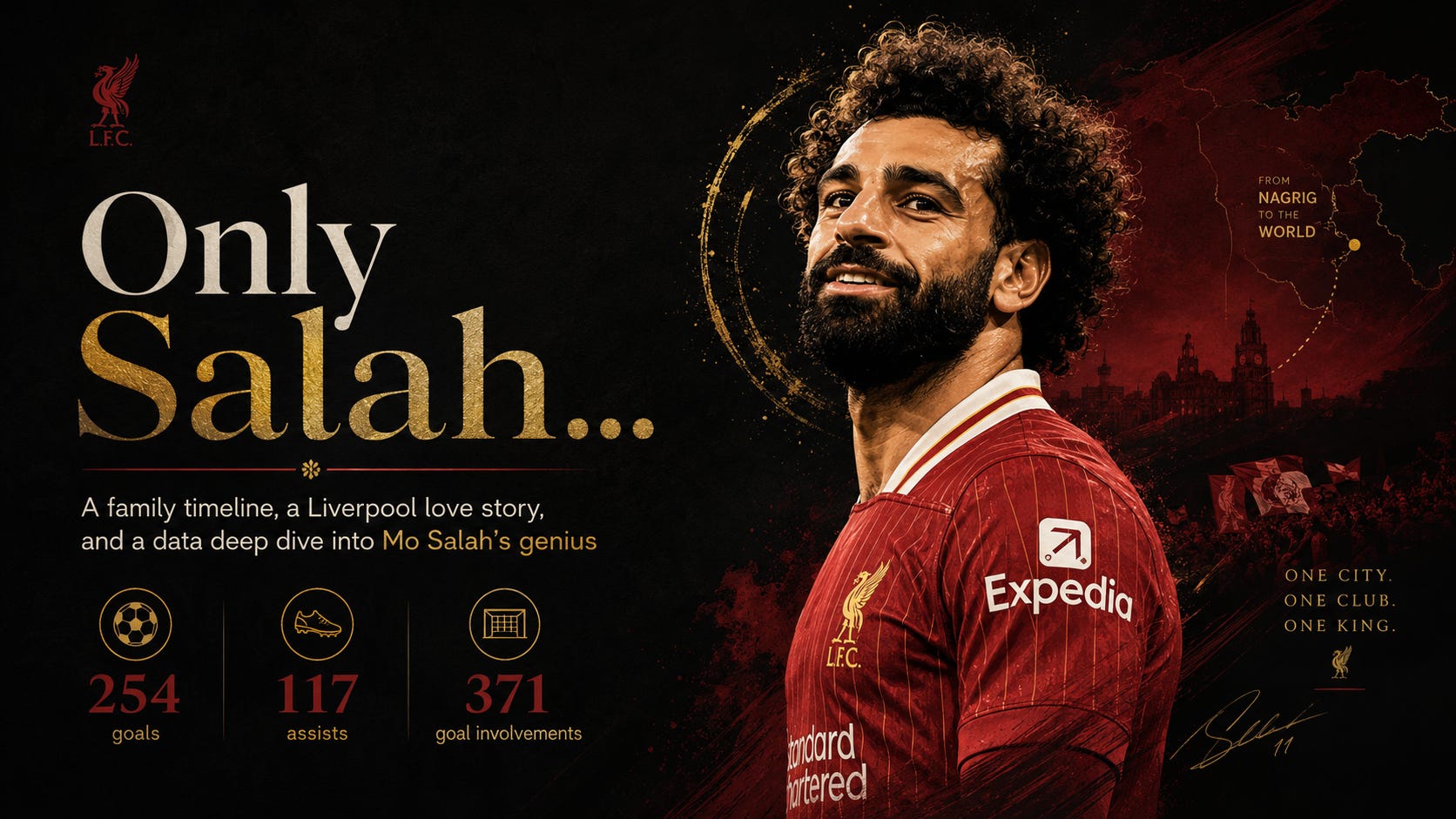
I was 42 when Mo Salah signed for Liverpool.
Maybe a strange place to start, because this is supposed to be about him. Goals, assists, records, trophies, big chances created, xG, xA, touches in the box, carries, threat created, all the tiny data goblins that have followed him around for almost a decade.
But Salah’s Liverpool career did not happen in my spreadsheet.
It happened in our house.
In the car. On the long drive north. It happened in the routine of packing scarves, picking the kids up from school early, stopping at Knutsford, seeing the red tide of fans moving through the services like some travelling religious order with Greggs steak bakes. Salah 11 shirts everywhere.
It happened in the living room, crying together in lockdown when there was no other joy. It happened in the garden playing footy. It happened in the kids’ school mornings “did you see that goal last night”. “Salah is better than…..” It happened in the stories my children tell about their own lives.
When Salah arrived, Liverpool had not won the league since I was 16.
I had a 12-year-old daughter, Lola, who was already a big Red. She had been seven months old when Istanbul happened, so technically she had lived through the miracle, but only in the way a baby lives through history. It was family folklore more than memory. Jesse was nine. He had grown up with our Liverpool. Hope, noise, nearly, chaos, the slip, a few outrageous footballers, the occasional glimpse of something enormous, then the usual emotional weather front rolling in over Stanley Park to piss it down all over our chips.
Lola had seen Suarez. She had seen Sturridge. She had seen Stevie, Phil and Raheem at their best. For a couple of years we had a nine-foot Fernando Torres mural on the wall by the stairs up to the kids’ floor. Nine feet of blonde-haired, red-shirted possibility. Then he broke her heart and left, because apparently that is what childhood football heroes do if you let them near interior design. The first song Jesse ever learnt was “Fernando Torres, Liverpool’s number 9”.
We had brilliant players.
We had glorious days.
We had not actually won very much.
Then Klopp arrived and the whole thing started to feel different. You could feel it in your bones, in your soul. Liverpool were on the rise. It was visceral. The football had pulse and teeth. The pressing was suffocating teams. Mané was already brilliant. Bobby’s genius was bubbling beneath the surface, that strange, sly, selfless football intelligence that made everyone around him look more dangerous.
We still had Daniel Sturridge too, and my word, what a footballer.
People forget how special Sturridge was, maybe because the injuries smudge the football. But when he was right, he was liquid class. Touch, timing, disguise, finish. A left foot that seemed to know the answer before defenders had read the question.
He was historically brilliant too. Sturridge was the quickest player in Liverpool history to 40 goals, reaching the mark in 45 games.
That mattered to me. It mattered to Under Pressure. It gave us a frame of reference. It told us what a frightening scoring pace looked like inside Liverpool’s record book.
The tragedy was that Sturridge was forged in a glass factory.
Then came Salah.
And the funny thing is, we had done the work.
On Under Pressure, we had gone through the numbers. Salah was not some random punt. His Roma data was exciting. Shot locations, progression, output, creative involvement, the way his profile might explode inside a Liverpool side that created better chances and played at a higher emotional temperature. I had told the kids to be excited.
I had absolutely no idea.
That is the thing about Mo Salah. You could know the numbers and still miss the scale of what was about to happen. I’m not sure even now we fully comprehend just how good he has been.
The first few months were almost confusing. Goals arrived too quickly for normal processing. Watford away. Arsenal. Southampton. Stoke. Everton. Bournemouth. Roma. City. Later, Chelsea, when he seemed to pause reality, shift the ball, and bend it into the top corner while Anfield briefly became a legalised riot.
At first we asked the sensible question.
Was this real?
In March 2018, we did an Under Pressure podcast called Mo Salah, One Season Wonder?
It looks funny now. It should. But at the time it was the right question. He was scoring at a rate that made analysts twitch. Our job was to work out whether this was a hot streak or the start of something much bigger.
The public saw the goals.
The data saw repeatability.
He was getting the right shots from the right places. He was arriving in the same horrible zones again and again. He was not living on screamers, deflections and statistical fluke. He was turning Liverpool’s attack into a weekly act of calculated panic. Full-backs knew what he wanted to do and still found themselves facing their own goal, legs scrambling, blood twisted, dignity leaking out onto the grass.
By the end of that first season, he had 44 goals and 14 assists.
Fifty-eight direct goal involvements.
One season wonder?
It became one of football’s longest-running jokes.
Only Salah.
Because that is where this phrase comes from.
It is the story of how his Liverpool career was discussed.
Only Salah has……
Only Salah became the sentence
There was a period where football data accounts became trapped inside their own Mo Salah loop.
Somebody would do something brilliant. Jota would score again. Palmer would go on a run. Bruno Fernandes would rack up chances and assists. Cunha would look like a one-man counter-attack department. A graphic would appear. A stat would start beautifully. A player would be praised. A comparison would be built.
And then, inevitably, the little red ghost would arrive at the end.
Only Salah has more.
It became a joke because it was true too often.
Opta, Sky, Squawka, FotMob, the whole cottage industry of football numbers kept walking into the same cul-de-sac. You tried to praise someone else and ended up praising Salah by accident. That is when a player stops being a player in the data and becomes the reference point.
Michael Reid at Opta put it perfectly. Players will not simply break records after Salah. They will become “the most since Mo Salah.” Or, more accurately, they will come after the words “only Mo Salah has more.”
That is the line. That is the whole thing.
Because this was never just Liverpool fans being precious about our lad. The language of football statistics changed around him. Salah became the ceiling stat. The caveat. The comparison point. The name sitting at the top of the table when the article was supposed to be about somebody else.
Sky Sports did it with Diogo Jota in 2022. Jota was flying, Liverpool had this ruthless penalty-box forward who seemed to turn every half-chance into a goal, and the praise still had to pass through the Salah checkpoint.
Only Salah had scored more Premier League goals than Diogo Jota that season.
Then Matheus Cunha goes on a fast-break tear and Sky are back there again.
Only Salah had made more from fast breaks.
Cole Palmer has his big moment, the media machine starts purring, and OptaJoe drops the same old red shadow across the graphic.
Only Mohamed Salah had been involved in more goals in all competitions among Premier League players that season.
Justin Kluivert starts scoring away from home.
Only Mohamed Salah has scored more Premier League goals away from home this season
.
Bruno Fernandes becomes the great creative reference point after arriving at Manchester United. FotMob and Opta Analyst put him at 140 Premier League goal involvements since his debut, which is enormous. Brilliant footballer. Huge influence.
Then the sentence turns up again.
Only Salah was ahead of him, on 193.
And my favourite version is Salah against Salah.
OptaJoe had to point out that Salah’s 2024 Liverpool output was only behind Salah’s 2018 Liverpool output. That is when the whole thing turns into a hall of mirrors. Only Salah has more than Salah. Of course he does. Who else was it going to be?
This is why the title of this piece is not just a tribute phrase.
It is the actual statistical grammar of his Liverpool career.
Only Salah.
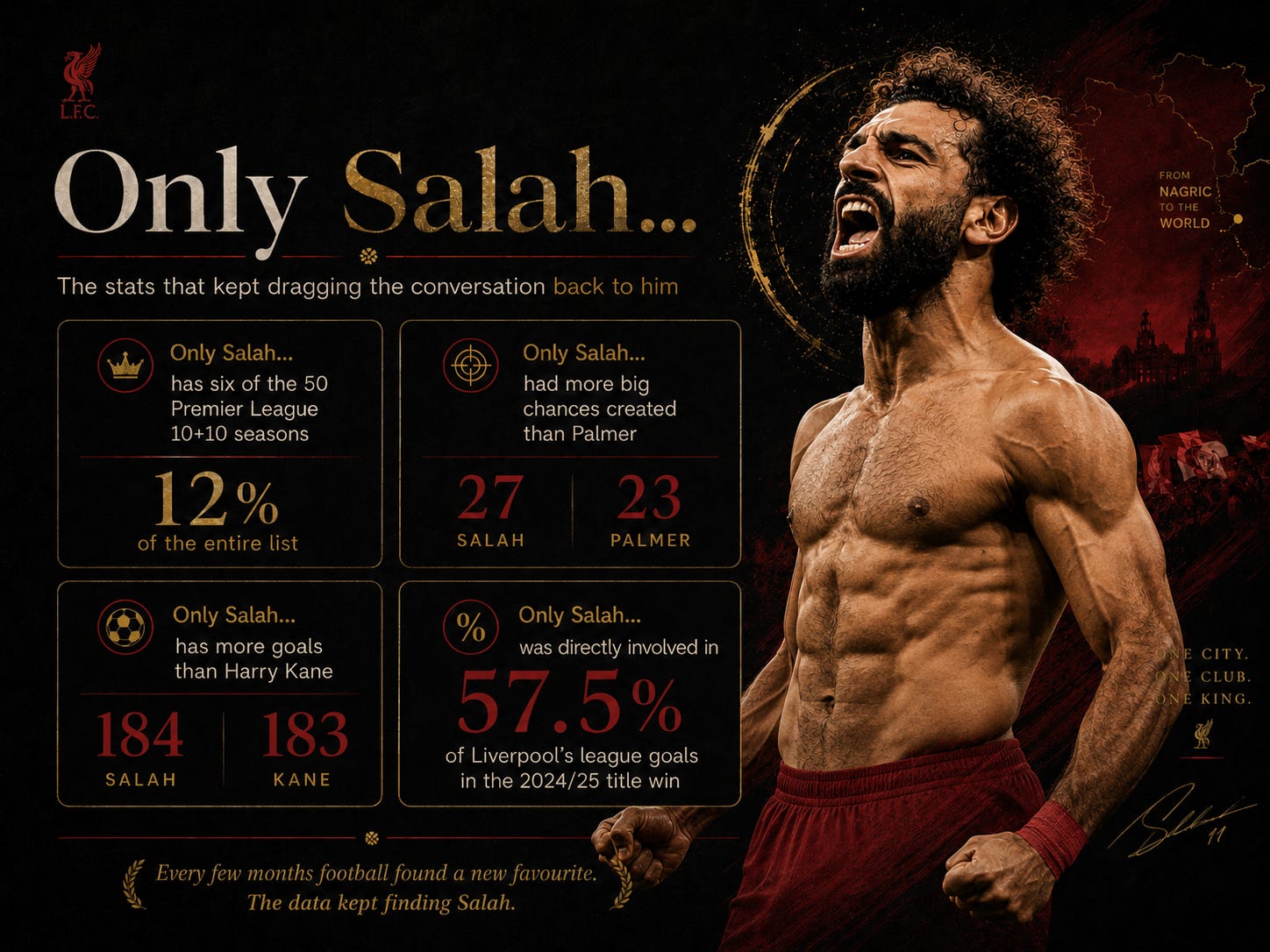
Only Salah has six of the 50 Premier League seasons where a player recorded 10 or more goals and 10 or more assists. Twelve per cent of the entire list belongs to one player.
Only Salah had more big chances created than Palmer.
Only Salah has more goals than Harry Kane across this stretch.
Only Salah has won more points than Haaland.
Only Salah was directly involved in 57.5 per cent of Liverpool’s league goals in a title-winning season.
Only Salah could be used to measure the league’s best goalscorer, the league’s best creator, the league’s best new star, the league’s best striker, the league’s best counter-attacker, and then still turn up in his own comparison like some sort of Egyptian footballing recursion glitch.
Michael Reid said Salah’s records were so ridiculous that Opta had to go beyond Premier League-era data. That is not normal. Opta’s Premier League database begins in 1992-93, which covers more than enough for most modern football arguments. With Salah, it was not enough. They had to dig deeper into Liverpool history because every new number kept threatening another old name.
Reid also said it became almost impossible to build a leaderboard where Salah was not sitting above the player they were trying to talk about, because he was so multifaceted.
That word matters.
Multifaceted.
Because if Salah had only been a scorer, the argument would have been simpler. If he had only been a creator, the argument would have been simpler. If he had only been a transition threat, or a big-game player, or an availability monster, or a penalty-box forward, or a wide creator, or a pressing outlet, or a record-breaker, you could have put him in a drawer and labelled it neatly.
But Salah kept ruining the filing system.
Goals? There he was.
Assists? There too.
Big chances created? Yes.
Touches in the box? Obviously.
Opening day goals? Him.
Old Trafford goals? Him.
African Premier League records? Him.
Liverpool records? Him.
Premier League records? Him.
European records? Him again, irritating everyone trying to have a normal day at work.
This is also why the media conversation always felt slightly off. It was not that Salah was ignored. That would be too simple, and it would not be true. He won awards. He made headlines. He scored too many goals to vanish.
But he was constantly under-contextualised.
The media never quite gave him the credit he earned. They praised him, obviously. They had to. You cannot ignore a man who keeps kicking the door down and then politely tidying the hallway afterwards. But there was always someone else. Someone newer. Someone more narratively convenient. Someone easier to romanticise. Maybe more aesthetically pleasing, someone more famous, someone more English.
At different times it was Harry Kane, the pure goalscorer. Then Kevin De Bruyne, the genius. Then Erling Haaland, the machine. Then Cole Palmer, the new creative darling. Sometimes even Salah’s own team-mates carried the more fashionable story. Mané’s fury. Bobby’s artistry. Virgil’s aura. Trent’s passing. Alisson’s calm. Liverpool were full of beautiful footballing arguments, and somehow the man with the numbers kept getting filed as “yeah, obviously him as well.”
But the stats never let the conversation escape.
Only Salah has more goals than Harry Kane.
Only Salah had more big chances created than Palmer.
Only Salah has won more points than Haaland.
Only Salah has six of the 50 Premier League seasons where a player recorded 10 or more goals and 10 or more assists.
Six of 50.
Twelve per cent of an entire Premier League achievement belongs to one player.
That is not normal greatness. That is leaderboard vandalism.
And we saw it right from the first awards conversation. In 2018, Salah won the PFA Player of the Year. Even then, the discourse bent towards somebody else. The Guardian framed the debate as Salah being a deserving recipient, while still saying nobody had been as “beautiful to watch” as Kevin De Bruyne. ESPN ran the same sort of debate, Salah or De Bruyne, with City’s dominance placed against Salah’s scoring explosion. De Bruyne himself said he had “no option” but to vote for Salah, which was maybe the most sensible public thing anyone said in the whole discussion. (The Guardian)
That became a pattern.
If Salah scored more, the other player had more control.
If Salah created more, the other player was more elegant.
If Salah produced again, the other player had the better narrative.
If Salah was available every week, the other player had a higher peak.
If Salah had the peak, the other player had the romance.
Every few months football found a new favourite.
The data kept finding Salah.
The record book
Because I was doing Under Pressure, Salah did not only arrive in our house as a player.
He arrived as a question.
How good is this?
How real is this?
Where does this sit?
That was the fun. The kids got the goals, the noise, the celebrations, the school bragging rights. I got all of that too, obviously. I am not dead inside. But I also got the numbers. The comparisons. The little historical tremors. The sense that something very strange was happening inside Liverpool’s record book.
Liverpool are not short of attacking legends. Always some great stood over his shoulder whenever he reached a milestone.
That is the thing. This is a club where the bar is Kevin Keegan, the reason I support Liverpool in the first place. Kenny Dalglish. Ian Rush. Robbie Fowler. Michael Owen. Fernando Torres. Luis Suarez, the greatest footballer I have ever seen live. Historic greats like Roger Hunt, Ian St John and even Gordon Hodgson. Then the Klopp front three, which at the time felt like three equal forces moving in beautiful chaos, but turns out, with the cold brutality of distance, was led by Mo.
We did not quite know that at first.
Mané was brilliant. Bobby was a genius. Coutinho was still there at the start. Lallana had ended the previous season properly embedded in Klopp’s team. There was even a real question about where Salah would play.
Then I saw him live.
I was second row of the Kenny. I cannot even remember the game with total confidence, which annoys me, but I remember the moment. Salah picked the ball up with his back to goal near the halfway line, knocked it past the left-back, and went.
I like fast lads. That is not exactly breaking news. But from three metres away, the biomechanics of it were ridiculous. The acceleration from dead was unbelievable. It felt like the air had been sliced open.
That was the first physical shock.
Then came the record-book shock.
By the time he reached 50 goals, the penny had landed so hard it cracked the table.
He was a freak of nature.
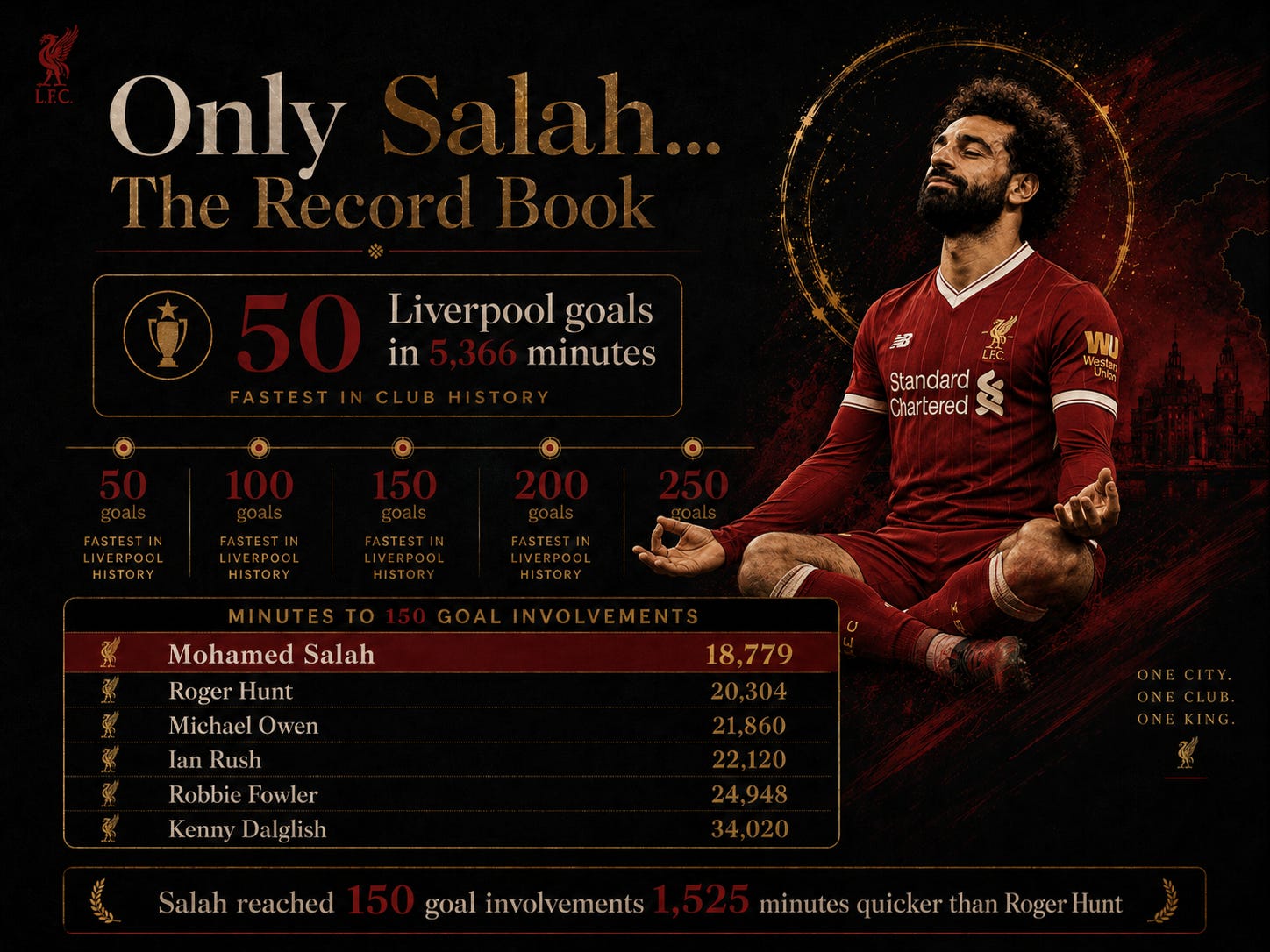
Salah reached 50 Liverpool goals in 5,366 minutes. That was roughly five and a half full games quicker than the next best. It was around 2,600 minutes quicker than Ian Rush, 2,400 quicker than Robbie Fowler, and 2,380 quicker than Michael Owen. That was me on UP, trying to explain why this thing already had historical heat.
All-time great production out performing all-time great players.
And then the silly bit.
He kept going.
The same trajectory carried past 100. Past 150. Past 200. Past 250.
Every time another landmark came into view, the old names lined up again, and Salah sprinted past them with the ball under his arm. On that same UP discussion, I talked about how the trajectory carried through the milestones, how Salah became Liverpool’s fastest to 250 goals and, in Premier League terms, faster to 250 than Aguero, Kane and Shearer.
Only Salah.
And the important thing is that it was never just goals.
That has always been one of the lazy ways to diminish him, even when people thought they were praising him. “Goalscorer.” Fine. Technically true. Also painfully incomplete. Calling Salah a goalscorer is like calling Anfield a building.
When you include assists, the same trend appears.
When Salah reached 150 direct goal involvements for Liverpool, he did it in 18,779 minutes. Roger Hunt, World Cup winner, Liverpool royalty, one of the great goalscorers in the club’s history, needed 20,304 minutes. Michael Owen needed 21,860. Ian Rush needed 22,120. Robbie Fowler needed 24,948. Kenny Dalglish needed 34,020.
Salah reached 150 goal involvements 1,525 minutes quicker than Hunt, 3,081 quicker than Owen, 3,341 quicker than Rush, 6,169 quicker than Fowler, and 15,241 quicker than Kenny.
In football language, that is almost 17 games quicker than Hunt, 34 quicker than Owen, 37 quicker than Rush, 69 quicker than Fowler, and 169 quicker than Dalglish.
I love Kenny Dalglish. Every Liverpool fan with a functioning soul loves Kenny Dalglish. This is not about diminishing gods.
It is about understanding what we were watching.
Salah was not joining Liverpool’s great forwards.
He was burning through them.
The family timeline
And while that was happening, our kids were growing up inside it.
Mo was in the stories. In the highlights. In the fireworks. We talked about him over breakfast before school. It almost became a ritual. Deeply embedded in their “core memories”, as they often reminded me with their Inside Out reference.
Jesse would be in the garden until eight at night, preparing to lead his school team to national finals, practising passes to Mo. He was a boy, so obviously the goals hit him straight in the chest, but for Jesse it was the passing too, he saw himself, still does, as a playmaker. The little reverse balls. The curled assists. The way Salah could be the scorer, the creator, the decoy, the entire tactical wrecking ball.
Then Jesse would go into school the next morning with playground ammunition.
“Did you see Mo’s goal last night?”
“I was at Anfield for that goal against Napoli…...”
For a Liverpool kid, Salah provided bragging rights on tap. School mornings filled with proof. Proof that your team mattered. Proof that your hero was better than theirs. Proof that the long drive, the traffic, the late nights, the cold feet, the car baguettes, our weird little traditions were part of something enormous.
We watched every game together. Most on TV. Many after the three-hour slog up to our Mecca. We had our routine. Where we parked. What we ate. The stop at Knutsford to see the sea of fans. Those details sound small until you realise that is where family life actually lives. In the repeated tiny rituals. The scarf in the car. The same services. The same walk. The same nervous jokes. The same feeling when the ground comes into view.
Mo was there for all of it.
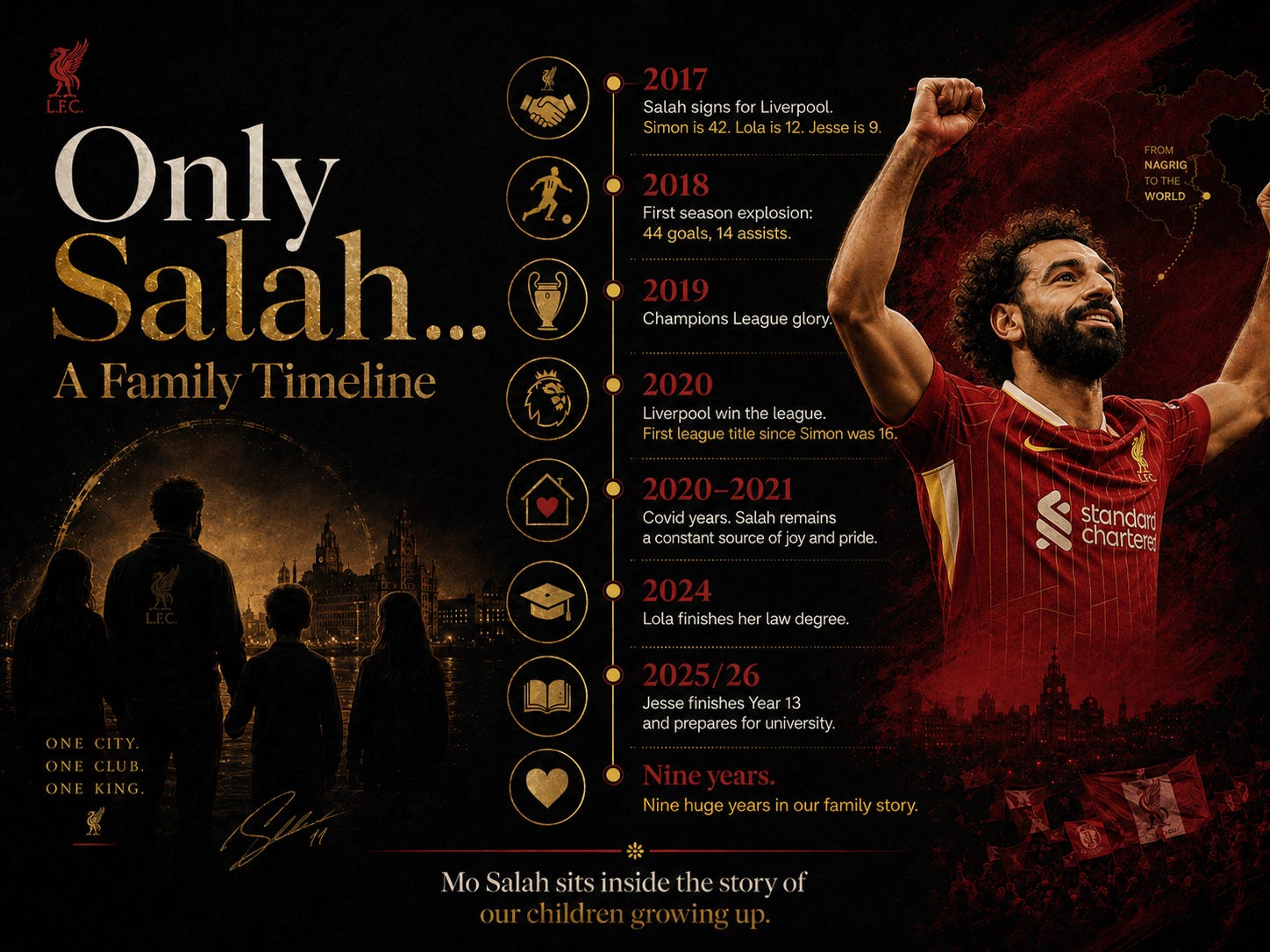
He was there when the kids were still kids. He was there through teenage years. He was there through Covid, when football was strange and empty and yet somehow still held bits of us together. He was there when Lola went from schoolgirl Red to university student, then finished her law degree. She was there for Barcelona too, which even Mo cannot top for bragging rights. Fair enough. There are some nights that sit outside the usual rules of sport.
Jesse was starting year five when Salah arrived. He is now about to finish year 13 and head off to university in September.
Nine years.
Nine of the most important years in our family story.
Even Katy, my Derby County season ticket holder wife, is now a Red. That might be one of Salah’s least discussed achievements. Forget the Golden Boots. Converting a Derby season ticket holder through sheer weekly brilliance should have its own mural.
The awards, the output, the evolution
And yes, about those Golden Boots.
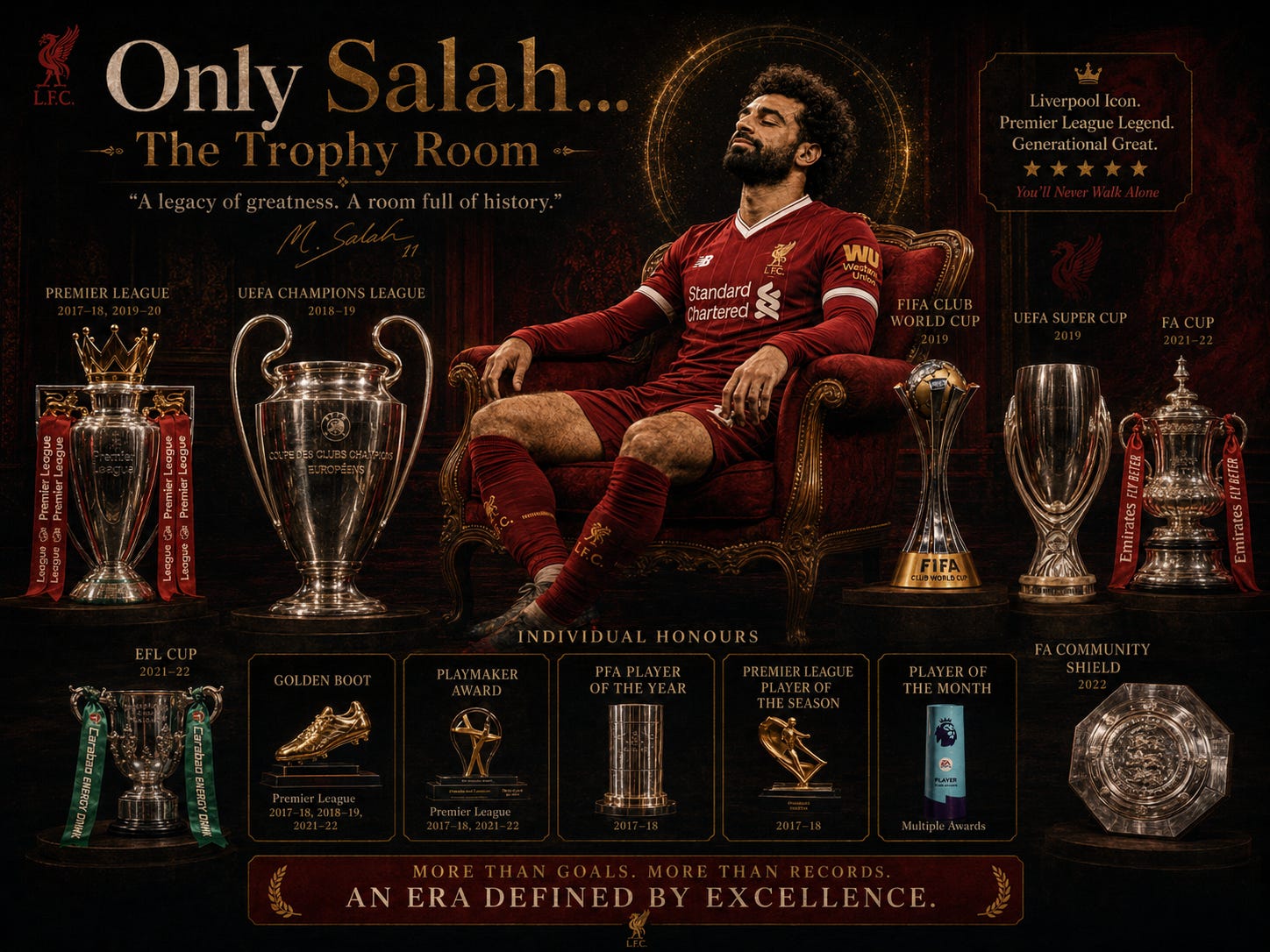
The Premier League’s own records page now lists Salah among its all-time greats, with only three players ahead of him for Premier League goals at the point of that article, Shearer, Kane and Rooney. It also notes the landmarks, records and individual awards that make his résumé look less like a football career and more like a clerical error. (Premier League)
But that is the thing with Salah. One list is never enough.
He won Golden Boots. He won Playmaker awards. He won PFA awards. He won more Player of the Month awards than anyone in history. In 2025, Reuters reported him becoming the first player to win the PFA Player of the Year, Premier League Player of the Season, Golden Boot and Playmaker award in the same season. They also reported that he became the first player to win the PFA Player of the Year three times. (Reuters)
Read that again.
Player of the Year.
Player of the Season.
Golden Boot.
Playmaker.
Same season.
That is the “Only Salah” problem in its purest form.
Because the media framing around him still found a way to be hesitant, qualified, slightly late, slightly awkward. In the same period where the numbers should have ended the argument, there were still debates about whether Palmer had overtaken him, whether Haaland remained the defining force, whether Saka was the league’s best wide player, whether De Bruyne’s legacy sat above his, whether Kane’s goalscoring purity carried more weight.
Darren Bent’s talkSPORT top-five discussion in January 2025 is a nice little example of the churn. Rodri, Haaland, Salah and Van Dijk were in the conversation, and the debate became partly about whether Cole Palmer should be included. That is how the machine works. Salah sits there with mountains of output, and the room starts asking whether the next shiny thing needs more flowers. (TalkSport)
Again, Palmer is brilliant. That is not the point.
The point is that the standards around Salah were always different.
Hazard could be celebrated for the dribbling. Haaland could be celebrated for the goals. Kane could be celebrated for the output. De Bruyne could be celebrated for the craft.
Salah needed to be all of them and then do it again.
In 2024/25, public data credited Salah with the most big chances created in the Premier League, 27, ahead of Bukayo Saka and Cole Palmer. (StatMuse) He would have smashed the assists record if only his teammates hadnt failed to score the 14 consecutive High Quality Chances he created, above 0.28 xG, to finish the season. Only scoring 2 of 19.
Only Salah.
That is why the “goalscorer” label has always irritated me. He has been the goalscorer, yes. He has also been the creator. He has also been the player who bends the entire right side of the pitch around him. He has also been the player who lets Trent be Trent, who gave Mané space, who found Jota, who fed Núñez, who created from ridiculous body shapes while two defenders tried to turn him into a sandwich.
On the latest UP tribute, Hamza described the evolution beautifully. Salah arrived as a dribbler who got shots, then layered up the rest of the game until he became a triple-threat player. Dribbler, shooter, creator, elite at all of them.
That is the proper football description.
He did not stay the same player.
He kept becoming new versions of himself.
Re-defining excellence.
The contract argument
During the first contract saga, there was a lot of wage structure chat. A lot of model chat. A lot of “can Liverpool replace him?” chat. A lot of people suddenly becoming amateur sporting directors in their pants on Twitter.
Clubs do have to think that way. Of course they do. Michael Edwards is not supposed to sit in a room shouting “pay the king” until someone brings him a gold pen. Football clubs have budgets, wage ladders, renewal cycles, risk models and succession plans.
But the football argument was already sitting there with its feet on the desk.
By his fifth season, Salah was already ninth in Liverpool’s all-time goalscorers. He had the second greatest goalscoring season in the club’s history. Once you adjusted for minutes, he was already ahead of the legends. In that UP contract episode, the argument was simple enough: fastest to 50, fastest to 100, fastest to 150, with the best goal and assist rate at those levels, and “nobody is close to him in Liverpool metrics.”
And still the question was, is he worth it?
That is Salah’s Liverpool career in miniature.
He kept having to prove things that should already have been settled.
Was the first season real?
Could he repeat it?
Could he do it when teams adapted?
Could he do it without Coutinho?
Could he do it when Mané became the media favourite?
Could he do it when Bobby’s legs went?
Could he do it after 30?
Could he do it under a new manager?
Could he create as well as score?
Could he remain worth the money?
Could he still sprint?
Could he still matter?
Only Salah.
In that contract discussion, there was a line that still feels true. No attacking player in the Premier League was doing what Salah was doing, maybe no attacking player in Europe outside the absolute monsters, and nobody in Liverpool’s history had done it. The argument was not that he was asking to be overpaid. The argument was that he was asking for value.
That is the bit people missed.
Value is not cheapness.
Value is output relative to cost, certainty relative to risk, availability relative to alternatives, and the probability of replacing the thing you are about to let walk out of the building.
By that point, Salah had already given Liverpool years of surplus value. In the same contract pod, I argued that among the top attackers in the world, if you looked at earnings per actual goal and assist, Salah was significantly the best value for money, around 27 per cent better than the next best attacker in that snapshot.
That is why the wage argument always felt upside down.
People were obsessing over what he might cost.
The bigger question was what it would cost to lose him.
Because replacing goals is hard. Replacing assists is hard. Replacing availability is harder. Replacing the gravitational field of a player that every opponent has to build their week around is something else entirely.
We have to do it now.
Availability
The goals are obvious. The assists are obvious. The records are obvious, or at least they should be by now. But Salah’s real genius might be the thing fans talk about least because it is hidden inside everything else.
Ability means nothing without availability.
He did not just produce. He was there to produce.
Again and again and again.
And that did not happen by magic.
No outfield player in the world has played more football in the last 9 years than Mo.
On the recent UP tribute, I compared Salah’s professionalism to the way Arsène Wenger changed English football’s relationship with food, recovery and preparation. Wenger arrived and became part of football folklore for helping players behave more like athletes. Salah feels like one of the next great steps in that story. In British football, he has been at the vanguard of what the modern professional footballer should look like, how he behaves, how he trains, how he respects the tools of his trade.
The cryo chamber. The oxygen. The yoga. The weight training. The nutrition. The recovery. The meditation. The constant search for another edge. The willingness to find experts, take what he needs, then craft his own solution rather than outsource his body to one guru with a stopwatch and a hoodie.
That autonomy matters.
A lot of players train hard. A lot of players hire specialists. A lot of players do extras. Salah seems to have built an entire personal performance ecosystem around one question.
How do I stay elite?
And the answer is there in the numbers.
He is an ultra-fast-twitch, high-intensity player who has played for Liverpool, Egypt, through Klopp’s pressing, through AFCON, through Ramadan, through endless travel, through title races, Champions League runs and emotional chaos, while averaging around 5,100 minutes a season for ten years. In that same discussion, I said that at 33, with only the second hamstring injury of his life, he might be even better at maintaining availability than he is at scoring and assisting.
That sounds unromantic.
It is not.
Availability is one of the great football skills. It is just disguised as admin.
It means your manager can build around you. It means your team-mates know where you will be. It means your club can plan. It means your kids can go to school the next morning and say, “Did you see what Mo did?” because Mo was almost always there to do something.
And when he was not quite playing well, he stayed in the game. That is another part of his genius. Some players disappear when the rhythm is wrong. Salah hangs around like a threat notification. He waits. He keeps making runs. He keeps occupying defenders. He gives himself one more chance to decide the match.
Then he does.
Only Salah.
The league he owned
The opponent record tells the same story in a different language.
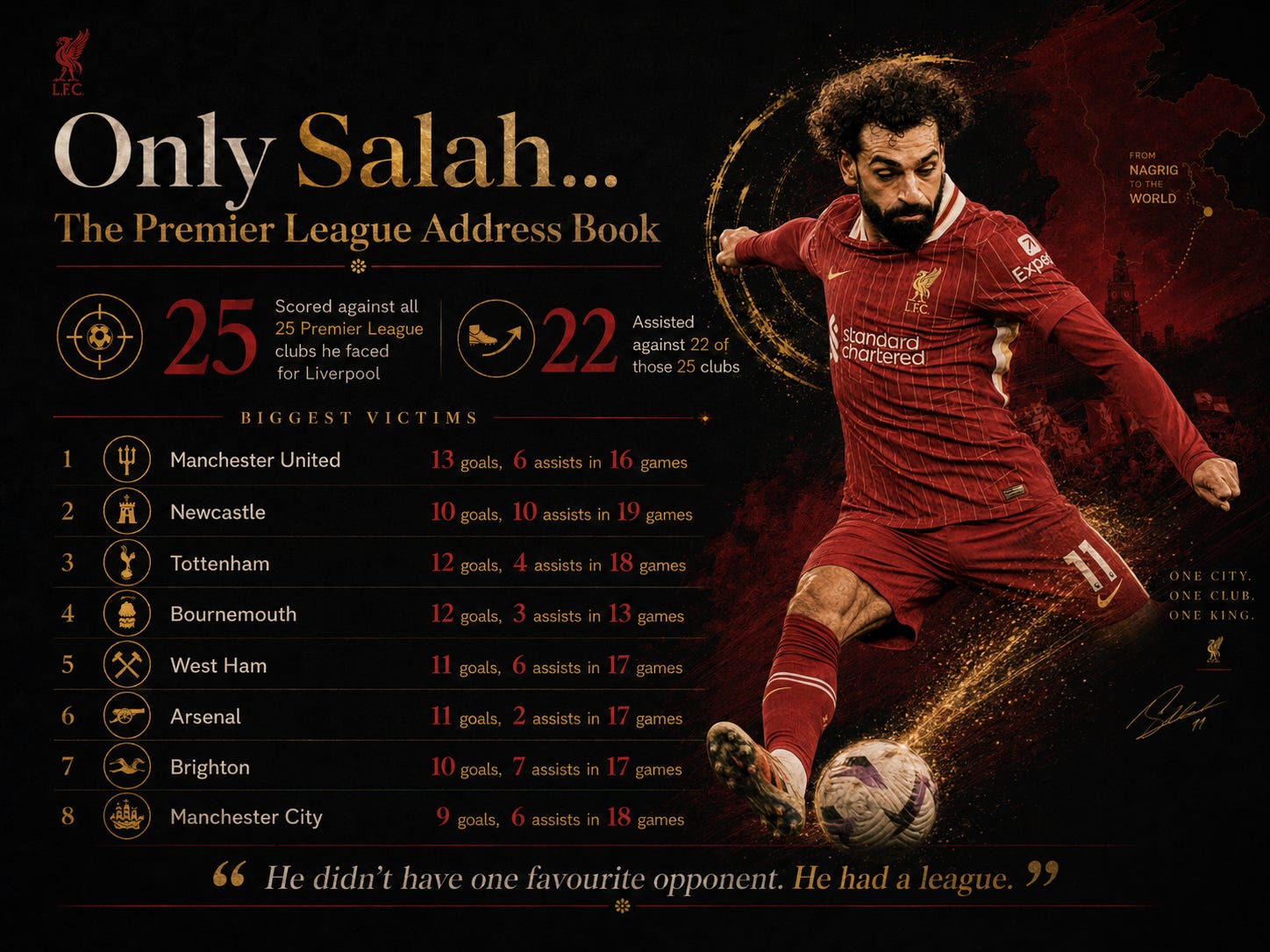
He has scored against every Premier League club he has faced for Liverpool. All 25 of them in my sample. He has assisted against 22 of those 25.
Manchester United, 13 goals and 6 assists in 16 league games.
Newcastle, 10 goals and 10 assists.
Tottenham, 12 goals.
Bournemouth, 12 goals.
West Ham, 11 goals and 6 assists.
Arsenal, 11 goals.
Brighton, 10 goals and 7 assists.
Even Manchester City, the hardest fixture of the era, got 9 goals and 6 assists in 18.
This was not one favourite opponent.
He had a league.
The moments and the factory
And he had moments.
The Roma game at Anfield remains one of the greatest individual Champions League performances I have seen. I said on UP that I would put it as a top-five Champions League game by any footballer. Go back and watch it. It is better than you remember. That is the mad thing. Even with all my Salah bias, and there is a bit, I am staggered by the bits I forget. The touch, the decision-making, the weight of pass, the violence of the finishes, the complete control of chaos.
The Chelsea goal.
The City solo goal.
The Old Trafford hat-trick.
The Alisson assist against United, shirt off, title drought screaming into the night.
The Napoli goal.
The penalties.
The far-post finishes.
The little passes slipped behind a full-back who thought he was safe.
The assist you only understand properly on the third replay.
The games where he did not look quite right and still walked off with a goal, an assist and three defenders emotionally frayed.
Those are the fireworks. They matter. Football is not a spreadsheet, however much some of us have tried to make peace with spreadsheets in public.
But the fireworks sit on top of the factory.
That is the bit people still underplay.
Across my Liverpool dataset, Salah has 254 goals and 117 assists in 426 appearances. That is 371 direct goal involvements, at almost one goal or assist per 90 minutes.
For nearly a decade.
From right wing.
Through title races, Champions League runs, AFCON, Ramadan, Covid, injuries around him, changing midfields, different forwards, different full-backs, different managers, ageing curves, tactical shifts and endless online nonsense about whether he looked sharp enough this week.
His completed season goal involvement totals are silly.
Then 37. Then 30. Then 42. Then 46. Then 44. Then 39. Then 54.
His “quiet” seasons were career years for almost everyone else.
That is how he warped reality. A 30-goal-involvement season became a discussion about whether he was declining. A goal and an assist became a normal Saturday. A penalty, a back-post finish, a clipped pass to the far post, a perfectly weighted ball into someone else’s run, all of it became routine.
At some point, Salah stopped being an event and became infrastructure.
And then came 2024/25, the final great absurdity.
On one shared calculation of goal contribution share in a league title win, Salah was directly involved in 57.5 per cent of Liverpool’s league goals. Top of the list. Ahead of Messi. Ahead of Henry. Ahead of Ronaldo. Ahead of Maradona.
A title-winning side, and he was involved in more than half the goals.
Dependency wearing a crown.
Only Salah.
The ending
That is why this cannot just be a thank-you piece. Gratitude is too small. It feels too polite for what he did.
Salah gave Liverpool fans numbers. He gave us trophies. He gave us records. He gave us the Champions League. He gave us the league title we had waited for since I was a teenager. He gave us nights we will never be able to explain properly to people who were not there.
But he also gave us something quieter and maybe more important.
He gave our family a thread.
From Lola at 12 to Lola finishing university. From Jesse in year five practising passes in the garden to Jesse heading off to uni. From the Torres mural heartbreak to the Salah era. From “maybe Klopp can build something” to “we are the best team in the world.” From long drives and car baguettes to Anfield nights that turned into family mythology.
Mo Salah sits inside the story of my children growing up.
This is different.
Players leave. Football moves on. It always does. There will be another right winger. Another chant. Another set of numbers. Another player for kids to copy in the garden until the light goes. Liverpool will still be Liverpool, which means hope, dread, noise, fury, romance, occasional stupidity and the eternal belief that the next season might just be the one.
But our Liverpool will never be quite this again.
A new phase of life is arriving for all of us. Uni. Solicitor. Grown-up kids. A quieter house. A Salahless Liverpool.
That is going to feel strange.
So yes, I will remember the records. The 10 and 10 seasons. The 57.5 per cent. The goals against United. The assists. The Chelsea goal. Roma. City. Napoli. The penalties. The curled finishes. The ridiculous muscles. The smile. The meditation. The professionalism. The way he trained, lived and played like a man who had made a private agreement with greatness and kept renewing the terms.
I will remember being one of his loudest advocates, defenders and supporters in the online fan community, partly because the argument was easy and partly because it still somehow needed making.
The media kept finding someone else.
The data kept finding Salah.
But mostly, I will remember the way he made my kids feel about Liverpool.
Proud. Loud. Certain. Spoiled in the best possible way.
Only Salah could do that.
And we were lucky enough to have him.
And then, in the end, maybe the spreadsheet can shut up for once.
Because the final word was never going to be mine.
It was always going to be ours.
“Mo Salah, Mo Salah, running down the wing…
Salahaaaaaaa…
Egyptian King.”
This is great, Si. Wonderful job.
Superb. Love this. I hope he goes out with a bang today ❤️