It's Time
Under cooked and over used. Losing 26 points deserves the sack
Liverpool are currently on track to finish 26 points worse off than last season.
Twenty-six points.
That is no little regression. That is not a bit of wobble. This is 80% a title-winning squad, with £450m of Talent added, yet we still watch the output collapse by that distance. A 26-point drop is the sort of number that should make the walls at the AXA wobble.
I believe Arne Slot should lose his job over that level of underperformance.
That does not mean every problem is his fault. It does not mean the players are blameless. It does not mean the recruitment has been perfect, the injuries have been irrelevant, (though the schedule has been kind) or the squad has been built like a fresh little Lego cathedral. Football is too messy for one-villain storytelling.
But the manager owns the team.
He owns the selection strategy. He owns the tactical identity. He owns the patterns of play. He owns the way the squad is used. He owns the relationship between freshness, fitness and fluency. He owns the performance falling off a cliff if the cliff has his fingerprints on the steering wheel.
So I wanted to look at the season through something more useful than post-match bitching.
How has the manager actually behaved?
Because a lot of the Slot debate has been weirdly shallow. One side says he is too soft. One side says fans do not understand training. One side says he should rotate. One side says he has no soft skills. Then everybody starts throwing around words like intensity, patterns, legs and mentality until the conversation looks like a tactical whiteboard after a a drunk Grealish got hold of the magnets.
The data gives us a better way in.
Across Liverpool’s last nine seasons, I’ve looked at four simple things.
Selection changes per game.
Players missing through injury each game.
Minutes played by substitutes.
Total player minutes across the season, including internationals; Fatigue doesn’t care what colour kit a player is wearing when they play.
Then I’ve added the individual player table, because team totals are useful, but the real truth usually lives in distribution. A squad can have enough total minutes and still have the wrong players carrying too much. A squad can use the bench and still fail to protect the spine. A manager can make changes and still be leaving the season in the legs of the same core group.
That is where this Liverpool season becomes interesting.
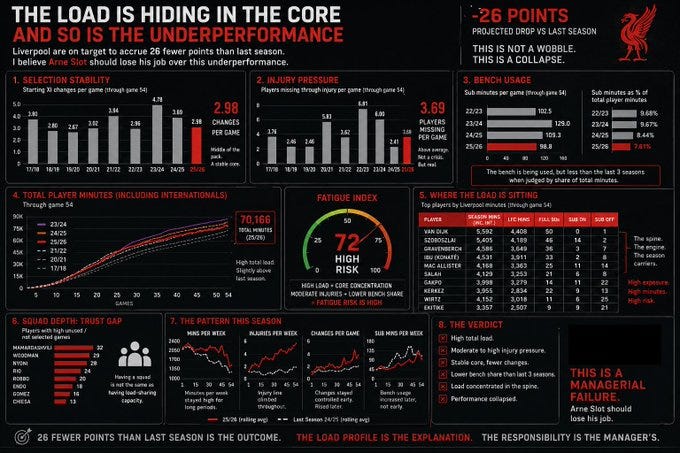
Through game 54, Liverpool have made 161 changes to the starting XI.
That is 2.98 changes per game.
Across the last nine seasons, that is right in the middle. It is nowhere near 23/24, when Liverpool made 258 changes at 4.78 per game. That season was a rotation tombola. Injuries, kids, cup games, Europa League, returns from injury, players coming back half-built, players disappearing again, Klopp trying to keep the circus moving while somebody kept cutting the ropes on the tent.
It is also below 21/22, when Liverpool made 3.94 changes per game in a season where they played everything. League, Champions League, FA Cup, League Cup, all the way to the final week. That was a high-functioning, deep, trusted squad being used like one.
This season, Slot is at 2.98 changes per game.
So a relatively low volume.
It is a stable-core season.
That matters, because when fans say “he keeps picking the same players”, the numbers partly support them. He has changed the team more than some seasons, less than others, but he has clearly leaned toward a trusted group rather than a deep spread.
Now let’s add injuries.
Through the same point, Liverpool have had 199 player-missing-games through injury.
That works out at 3.69 players missing through injury per game.
Not the easiest of the seasons, It is above 18/19, 19/20 and 24/25. It is roughly in the same band as 17/18 and 21/22. So availability has been a genuine factor. The nonsense of Isak and the Saga he and his agent played out to get a little more £££££££ costing him the first two blocks, then his unfortunate leg break from the Spurs thug. Poor Leoni doing his ACL on his debut. Conor Bradley’s brutal knee injury, impossible to predict nor protect him from. Then Endo’s ankle, but that was in block five when he’d barely played at all anyway and Mamardashvilli’s knee gash, costing him a couple of games. Poor Hugo’s achilles which will cost him the best part of a year but for this analysis just 6 games. The rest have been largely hamstring and hip flexor issues not caused by impact.
But it is not 20/21. It is not 22/23. It is not 23/24. Those seasons were proper injury carnage. 22/23 was 6.81 players missing per game. 23/24 was 6.00. 20/21 was 5.83, which still feels less like a football season and more like a medical case study with crowd noise.
So we have to be fair.
Slot has not had a perfectly fit squad.
He also has not had an injury crisis big enough to explain a 26-point regression. 7 Premier League sides have seen more games lost to injury and up to the end of February we were actually 12th in that league.
That is the line for me.
Injuries can explain how it takes longer for player, partnerships and units to gel, to synchronise. But not for any of those, at any point during the whole season. They can influence how many minutes the “core” lads play. Would Leoni have eased the ridiculous burden placed on Virgil? By how much? Are we really convinced Slot would be playing an 18 year of Centre Back for >1000mins? The midfield has been largely free of injury yet the Big 3 have played 50% more than Curtis. Of the 35 PL games played so far, one of either Ekitike or Isak have been available for 32 of them. Positionally, only RB 9 games and the keeper have not had a first team player available for every game. I’m being kind here because Mamar is hardly a replacement level goalie.
Can they really explain a collapse of this size by themselves.
Especially when we look at the squad-use profile.
Liverpool have used 5,337 substitute minutes through game 54. That is going to be influenced considerably by the 29 enforced substitutions (25 soft tissue) in game.
That is 98.8 minutes played by substitutes per game.
Compared with the old three-sub era, that is high, obviously. The rules changed, and comparing raw sub minutes from three-sub football with five-sub football is how spreadsheets become haunted.
The useful comparison is the recent five-sub period.
22/23, 102.5 sub minutes per game.
23/24, 129.0.
24/25, 109.3.
25/26, 98.8.
So Slot is using the bench, but less than the previous three seasons. That becomes even clearer when we look at sub minutes as a percentage of total player minutes.
22/23, 9.68%.
23/24, 9.67%.
24/25, 8.44%.
25/26, 7.61%.
That number is doing a lot of work.
Because Liverpool’s total player minutes are not low.
Including internationals, Liverpool players have already carried 70,166 total minutes. That is slightly above 24/25 at the same point, close to 23/24, and above most of the earlier seasons. Probably because of the volume of International starters we have (More evidence against the underperformance).
So this is the shape of the season.
High total player minutes.
Moderate injury pressure.
Moderate starting XI changes.
Lower percentage of minutes absorbed by substitutes than the previous three seasons.
That means the load is not vanishing.
It is concentrating.
And when you look at the individual player table, you can see exactly where it is going.
Van Dijk has played 5,592 season minutes, including 4,408 for Liverpool, with 50 full 90s. A Career high at 34 years of age
Szoboszlai has played 5,405 season minutes, 4,189 for Liverpool, with 46 full 90s. A second career high in a row, 40% higher than his previous career max.
Gravenberch has played 4,586 season minutes, 3,649 for Liverpool, with 36 full 90s. Career high.
Konaté has played 4,531 season minutes, 3,911 for Liverpool, with 33 full 90s. Career high.
Mac Allister is at 4,168 season minutes. Career high.
Wirtz is at 4,152. Career high.
Salah is at 4,129.
Gakpo is at 3,998.
Kerkez is at 3,955. Career high.
Ekitike is at 3,357. Career high
There is your season.
The team-level data shows stable core. And historic data would show top 6 sides who have 8 First teamers available for >80% of PL games usually win the league.
The player-level data gives you the names.
This squad load is not being evenly shared. It is being carried by a core group who are not just starting games, they are finishing them too. Van Dijk and Szoboszlai are being abused. They are structural pillars being asked to hold the roof up while the load grinds them into dust.
And Szoboszlai is the one that really jumps out.
Midfield minutes have a huge metabolic cost. They are repeated accelerations, decelerations, pressing actions, recovery runs, duels, scanning, decision-making, transitions, second balls, third balls, and the lovely modern football requirement to be everywhere all at once while people online call you lazy because your twentieth sprint was slightly less cinematic than your first.
Forty-six full 90s for Szoboszlai is not load management. It is reliance. Borderline abuse. Definitely born of desperation.
Van Dijk having 50 full 90s is also enormous. Centre-backs are often treated differently because they can tolerate high minutes better than midfielders and wide players, depending on the team model. But Liverpool centre-backs do not live in a retirement village. They defend big spaces. They hold a line. They manage transitions. They sprint back toward their own goal. They concentrate under pressure. They are constantly making risk calculations.
At his age, with that exposure, its more desperation.
Then Konaté. Big season minutes, huge Liverpool minutes, 33 full 90s. With his injury history, that is not a small detail. That is exactly the type of player who should make a performance department twitch when the load graph starts leaning forward. But maybe, just maybe, he is the example of someone who benefitted from the reduced training intensity and loads.
Gravenberch has become a workload monster. Great, in one sense. Development, trust, status, influence. But it is also a major exposure jump. When a player’s role changes from talented contributor to season carrier, you need to watch the cost.
This is where the phrase “using the squad” becomes almost useless.
Slot has used bodies.
But has he used load-sharing capacity?
That is different.
When a season behind fans count how many players a team has in each position, crunch the numbers and figure there is somewhere around 5400mins per position for a top European side.
Grav+Endo
Mac+CJ
Bradley+Frimpong
Kerkez+Robbo
Konate+Gomez with Virgil+Leoni, nicely covered, but what happens if results go a little wrong? What about a month of defeats, is a manager going to stick to his loading strategy or put his best XI on the pitch at all costs until his job is safe?
Managers count wins, physiology counts stress, workload.
A player coming on for 12 minutes is not sharing the season load with Szoboszlai. He is giving him a sip of water while Szoboszlai still drags the piano up the stairs, but he even stopped doing that with some players. Szobo has only been subbed twice all season and not at all in the League.
What looks like a “Squad player” on paper turns into a bench warmer when the boss is terrified for his job.
Chiesa has 29 sub appearances and 913 Liverpool minutes. Rio has 19 sub appearances and 780 minutes. Nyoni has 10 sub appearances and 244 minutes. Those minutes matter, but they are not the same as genuine protection for the core.
You can say “he made five subs” and still have the key players carrying the season.
You can say “he rotated” and still have the same spine absorbing the most damaging load.
You can say “the squad is big” and still have only 13 or 14 players the manager truly trusts in serious games.
And that is where I think Slot has failed.
Because this is not just a fatigue story. This is a performance story. About optimising resources. Helping his best players perform at their peak, with freshness and clarity of thought, cohesion and synergy with their team mates and in their units.
Liverpool are on target to drop 26 points from last season. That is the central fact. The load data does not excuse that. It explains part of the mechanism.
The manager has kept a stable core. He has used the bench, but less as a share of total load than recent seasons. Injury pressure has climbed, but selection behaviour did not change enough early. The same core players have carried huge exposure. The team has looked flat too often. Output has dropped too far. It has been far too accepted that Liverpool get out run, in both total distance, Sprints and most importantly High Speed distance.
That isn’t just unfortunate. That is managerial. Flawed strategy.
Now, to be clear, I understand the case for stability.
A new manager needs repetition. Tactical ideas need reps. Relationships need reps. Build-up needs reps. Pressing triggers need reps. Rest defence needs reps. The eight needs to know when the full-back has gone. The centre-back needs to know when the six has dropped. The winger needs to know when to hold width and when to attack the inside channel. The whole thing needs shared pictures. But we are 54 games in and still dont see it, in spite of the massive volume of gametime for favourites.
You cannot create tactical fluency by changing half the side every week.
So early in the season, I can understand Slot leaning on a core. In Block One its normal. Smart
I can understand him wanting rhythm.
I can understand him wanting his best players to live the game model rather than just hear about it in meetings while the sports science staff point at colour-coded charts and whisper about readiness.
But that argument has an expiry date.
If the team is fresh, improving and winning, fine.
If the team is not fresh (even with all the days off), not improving and heading for a 26-point collapse, the same behaviour becomes part of the charge sheet.
That is where we are.
Managers are always juggling three things.
Freshness.
Fitness.
Fluency.
Freshness is whether the player can produce today.
Fitness is whether the player has enough chronic load to tolerate the demands of the game.
Fluency is whether the team functions together.
Fans want all three immediately, preferably with a clean sheet and a left-footed switch that gets clipped into a highlights thread by 6pm.
Managers have to choose where to place the stress.
Slot appears to have protected fluency and core stability. The cost has been freshness and wider squad readiness. The craziest part is that he tried to mitigate the selection strategy by the flawed training load strategy. The team has not improved enough to justify that trade-off.
That is the heart of it.
If you are going to overload the core, the output has to be worth it. If you are going to have light training loads to allow freshness on matchday, you’d better not pick up soft tissue injuries in game.
If Van Dijk, Szoboszlai, Gravenberch, Konaté, Mac Allister, Salah, Wirtz, Gakpo, Kerkez and Ekitike are going to carry this much, the team has to look coherent. It has to look drilled. It has to look powerful. It has to look like the sacrifice is buying something.
Too often, it has not.
And that is where this stops being an abstract sports science discussion and becomes a judgment on the manager.
A 26-point drop is not just a few bad games. It is a season-long failure of performance stability.
It suggests the balance has been wrong.
Wrong between starting continuity and squad freshness.
Wrong between tactical repetition and physical freshness.
Wrong between trust in the core and development of usable alternatives.
Wrong between less intense training and pushing physiological capacity.
Wrong between waiting for rhythm and reacting to warning signs.
The rolling averages graphic tells that story visually. The minutes per week stay high through the central stretch. The injury line creeps up. The changes line stays relatively controlled for long periods, then rises late. The sub minutes trend also appears to rise later.📷
That looks like a manager becoming more protective after the pressure has built, rather than building protection into the season early enough.
And that is a problem.
Because fatigue does not wait politely until the manager has finished installing his automatisms. It accumulates. It hides. It nibbles away at top-end output. It blunts decision-making. It makes pressing look half-hearted. It makes a player arrive a fraction late. It makes repeat sprints disappear. It turns a sharp pass into a lazy pass and then everyone on Twitter starts diagnosing mentality from their sofa.
Fatigue often looks like bad attitude to people who do not understand the body.
But it is still the manager’s job to prevent the team from repeatedly looking like that.
Not alone. Of course not. He has staff. He has medical. He has performance. He has analysts. He has recruitment people above him. He has players with agency and responsibility.
But the manager is the point where all of it becomes a team.
And the team has underperformed.
This is why I do not buy the idea that days off are THE scandal.
Days off are not magic. Training harder is not magic. Running more is not magic. Rotation is not magic. A player can have two days off and still be carrying too much match exposure. A player can train lightly and still be overloaded. A player can start every week and technically be “available”, while physically losing the very qualities that make him elite.
The issue is the whole load ecology.
And this season’s ecology looks wrong.
High total load.
Stable core.
Lower sub-minute share.
Moderate to high injuries.
Massive exposure in the spine.
A points collapse.
At some point, the explanation becomes the indictment.
The manager has not got enough out of the squad. When did you watch a Liverpool game this season and see a performance better than the sum of its parts? The performance drop is too large. The load distribution suggests a core that has been asked to carry too much, while the wider squad has not been turned into reliable load-sharing capacity. The tactical fluency has not developed enough to justify the lack of protection. The results have not protected the process.
That is why I think Slot should go.
Because a manager inheriting this level of squad, who were on a trajectory for 94points when Klopp announced his retirement, then still managed 82. Which returned to the previous seasons trajectory of 94 points in his first 5 months before securing a title. Who was rewarded with £450m worth of shiny new toys, including 3 club record signings in one summer. Cannot oversee a projected 26-point drop and keep pointing at context as though context is a points refund machine.
Context explains.
It does not absolve.
The injuries explain some friction. The schedule explains some fatigue. The international minutes explain some load. The new tactical model explains some inconsistency. The player table explains some of the physical flattening. The tragedy explains some motivation loss.
But the league table is still the league table.
And if the team is on course to be 26 points worse, the manager’s decisions have to be central to the analysis.
This is also where the individual load picture becomes uncomfortable.
Van Dijk with 50 full 90s.
Szoboszlai with 46.
Gravenberch with 36.
Konaté with 33.
Mac, Wirtz, Salah, Gakpo, Kerkez, Ekitike all in the high-exposure group.
That is a lot of load in the players who define the team’s structure. If that core dulls, the whole team dulls. If that core loses sharpness, the tactical model loses sharpness. If that core is asked to carry too much, then the manager is gambling the season on the same people repeatedly producing under growing stress.
And when the output drops, the gamble has failed.
That does not mean every one of those players should have been rested constantly. That would be childish analysis. You still need your best players on the pitch. You still need continuity. You still need leaders. You still need to win the next game.
But load management is not just about removing players. It is about planning the season so that the same few players are not always the answer to every question.
That is where Liverpool have looked weak this year.
Too much has sat in the core.
Too many players have been bodies rather than trustable solutions.
Too many minutes have been managed late rather than prevented early.
Too often, the team has looked like the cost of stability arrived before the benefits.
And again, if the points total was strong, we would talk about this differently. We would say Slot is squeezing the squad, trusting his leaders (Mo aside), building rhythm, managing a tricky year. Winning changes the language around every decision.
But losing 26 points changes it back.
This season does not look like a small adaptation cost. It looks like underperformance. 16 months as a 62 point team and its getting worse.
The data does not scream that Slot is lazy, soft, clueless, or any of the cartoon words people reach for after a bad result. It says something more precise.
His Liverpool have carried a high load through a stable core, with less bench load absorption than recent seasons, rising injury pressure due to poor training optimisation, and enormous exposure for key players.
That can be a strategy.
It can also become a failure.
At 26 fewer points, it is a failure.
That is where I land.
Slot’s job was not just to install ideas. It was to maintain performance while doing it. Liverpool should not be drifting this far below last season. The squad has issues, maybe. The injury pattern matters, maybe. The tragedy matters, yes. But the manager’s behaviour has contributed to a load profile that has left the core exposed, the wider squad underdeveloped as genuine load-sharing capacity and vulnerable to injury, and the team nowhere near good enough.
So when people ask whether this is a fatigue issue, a tactical issue, a selection issue, or a squad issue, my answer is annoying but honest.
Yes.
It is all of them.
And the manager sits at the junction.
That is why the job should be under serious threat. Because the season-long numbers, the load pattern, the individual exposure, and the projected points drop as a consequence of the underlying performance numbers all point to the same conclusion.
This has not worked.
Liverpool are too big, too resourced, and too talented for a 26-point regression to be treated as a difficult learning year.
The load is hiding in the core.
The underperformance is hiding in plain sight.


Great article. Focusing on the “core” players, with the World Cup on the horizon do we have a potential injury issue in the post for next season, especially if we repeat what we have done this season?
Really interesting read.
"The injuries explain some friction. The schedule explains some fatigue. The international minutes explain some load. The new tactical model explains some inconsistency. The player table explains some of the physical flattening. The tragedy explains some motivation loss."
That passage looks like whatever the opposite of marginal gains is. There are factors in it that all clubs have to manage, and some that are unique to Liverpool. But the combination of them is important, to me at least.
In terms of the missed-games through injury list, are any of the teams with more games lost higher than us in the table?